American Foods Banned in Europe: The Real List
I read a dozen of these listicles. Roughly half the claims were wrong, stale, or sloppy with the word 'banned.' Here's the fact-checked version, sorted into true, overstated, and false.
There’s a genre of article you’ve definitely seen: “15 American Foods Banned in Europe,” usually illustrated with a sad-looking Pop-Tart. They rack up millions of views, and I understand why: they tap a real and reasonable suspicion that American food plays by looser rules. The frustrating part is that they’re often wrong, in ways that undercut the legitimate point.
I read about a dozen of the currently-ranking versions. By my count, roughly half the individual claims were wrong, out of date, or so sloppy with the word “banned” as to be meaningless. A drink described as “banned in Europe” was reformulated a decade ago. A candy called “illegal in the EU” is sold there every day in a different recipe. An ingredient “banned in Europe” is actually permitted with a warning label.
So this is the fact-checked version. I’ve sorted the common claims into three buckets (true, overstated, and false) and given you the primary source for each. The real list is shorter and more interesting than the viral one.
A note on language first, because the whole genre abuses it: “banned” should mean the thing itself is prohibited. It does not mean “the American recipe isn’t sold here,” “it carries a warning label,” or “a company chose to reformulate.” Those are real and worth knowing, but they aren’t bans, and collapsing them all into “BANNED” is exactly how these lists lose the plot.
Bucket 1: True (actually banned, or were)
These hold up. The ingredient is genuinely prohibited in the EU and the American version contains it.
Potassium bromate (in bread and flour). True, and the strongest case there is. The EU banned this flour improver in 1990; the UK from April 1, 1990; 40-plus countries since. The US still permits it at 75 ppm. The animal carcinogenicity data are reproducible and run through a mechanism (oxidative DNA damage) with real human relevance. This one earns the alarm. Full story in potassium bromate; quick status on the ingredient page.
Azodicarbonamide (the “yoga mat chemical,” in some breads). True. This dough conditioner is not permitted as a food additive in the EU; the US allows it up to 45 ppm. The “yoga mat” framing is tabloid (it’s also used in foamed plastics), but the underlying regulatory gap is real. (azodicarbonamide ingredient page.)
rBGH / rBST (synthetic growth hormone in dairy). True. The EU banned recombinant bovine growth hormone and milk from treated cows; it’s used in US dairy. (ingredient page.) Note the EU objection here is partly animal-welfare and partly a precautionary read of the human data, not a settled finding of human harm.
Ractopamine (in pork and some beef). True, and dramatic: the feed additive is banned or restricted in roughly 168 countries, including the EU, China, and Russia. (Michigan State University.) The EU won’t accept beef or pork from animals fed it. The US permits it. Worth knowing the human-safety case is genuinely contested (US and Codex authorities set residue limits they consider safe), but as a regulatory fact, the ban is real.
Brominated vegetable oil (BVO): true, but read the asterisk. The EU never authorized BVO, so it’s long been effectively banned there. The catch: the US revoked it too, effective August 2024. So as of now, both sides have banned it, and any listicle still presenting BVO as a live “America permits this poison” example is stale. The 54-year story is worth telling (see BVO), but the present-tense framing is out of date. (FDA.)
Bucket 2: Overstated (true-ish but sloppily framed)
These contain a real kernel, but the “banned” headline distorts it. This is where the genre does its most damage, because a reader can’t tell the careful claim from the careless one.
Synthetic food dyes (Red 40, Yellow 5, Yellow 6; in candy, cereal, Pop-Tarts). Overstated. These dyes are not banned in the EU. They are permitted, but any food containing them must carry the warning: “may have an adverse effect on activity and attention in children.” (ScienceInsights on Red 40.) That label, tied to the 2007 Southampton study, is so commercially toxic that most European manufacturers voluntarily reformulated to avoid printing it. So the dyes aren’t banned; they’re labeled into near-disuse. That’s a fascinating regulatory mechanism, and “banned” erases it entirely.
Skittles. Overstated bordering on false. Skittles are sold across the EU, in a reformulated recipe using natural colorings like paprika extract and black carrot juice instead of synthetic dyes. The American recipe isn’t banned; it’s just not the recipe sold there. (Chowhound.) And in the US, Mars removed titanium dioxide from Skittles at the end of 2024, so even the “contains TiO2” version of the claim is now dated. “Skittles are banned in Europe” is one of the internet’s most durable food zombies.
Pop-Tarts. Overstated, same mechanism. The objection is the Southampton dyes (Yellow 5, Yellow 6, Red 40). Those aren’t banned in the EU (they require the warning label), and reformulated versions are sold. “Pop-Tarts are banned in Europe” is, at best, “the US recipe would need a warning label and is usually reformulated for sale.” (Mashed.)
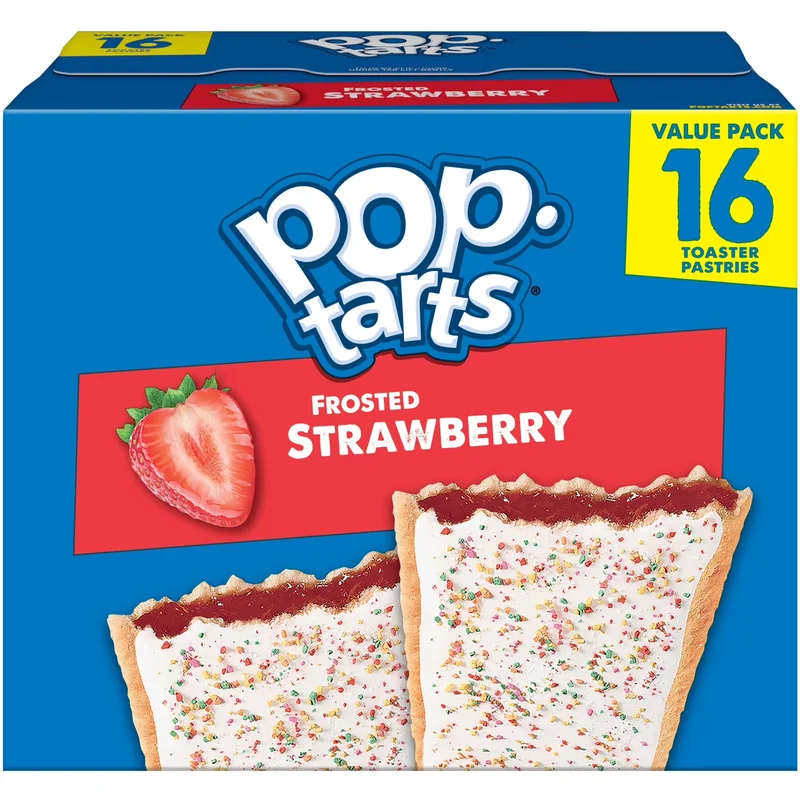
The box in question. The dyes carry the EU warning-label rule, not a ban; TBHQ (E319) is permitted in the EU only in specific categories at capped levels.
Mountain Dew. Overstated and largely stale. The claim hangs on BVO, which the US banned federally in 2024 anyway. PepsiCo announced in 2014 that it would remove BVO from Mountain Dew and completed the reformulation over the following two years, so the additive stopped being a live differentiator nearly a decade before the FDA acted. (BVO explainer.) Citrus Mountain Dew is still widely cited as “banned in Europe” on the strength of an ingredient the company retired around 2016.
Chlorine-washed chicken. Overstated in the way that matters most. Yes, the EU prohibits the chlorine rinse (and won’t accept US chicken processed that way). But the framing that chlorine makes American chicken dangerous is wrong on the science: EFSA found the antimicrobial washes themselves safe at the concentrations used, and most US plants have shifted to peracetic acid (essentially vinegar and hydrogen peroxide) anyway. The EU’s real objection is structural: it regulates pathogens throughout the supply chain rather than relying on an end-of-line wash. The practice is restricted; the “toxic chlorine chicken” panic is overstated. (ingredient page.)
Bucket 3: False or hopelessly muddled
These show up on the lists and shouldn’t.
“Farm-raised salmon is banned in Europe.” False as stated. Europe farms enormous quantities of salmon (Norway and Scotland are among the world’s largest producers). What’s true is narrower: the EU banned canthaxanthin for direct human consumption over retinal-damage concerns, and regulates the carotenoid pigments used to color farmed salmon flesh. (European Parliament Q&A.) “A specific coloring agent is restricted” is not “farmed salmon is banned in Europe,” which is plainly false.
“BVO-containing American sodas are banned in Europe” (present tense). Effectively false now. As covered above, the US revoked BVO in 2024 and the major brands reformulated long before. Presenting this as a current US-vs-EU gap is simply out of date.
Generic “ultra-processed American foods are banned in Europe.” False as a category claim. Europe sells plenty of ultra-processed food: the UK gets roughly half its calories from it, comparable to the US. There’s no EU “ban on processed food.” The real differences are specific additives (the true bucket above) and, separately, consumption patterns, which is a different conversation entirely. We get into that in Why do I feel better in Europe?.
Why the genre gets it so wrong
It’s worth a sentence on why these lists are so unreliable, because the pattern is instructive.
They copy each other. A claim enters the ecosystem (“Mountain Dew banned over BVO”) and gets recycled across dozens of sites for years after it stops being true, because nobody rechecks the primary source. They conflate categories: a warning label, a voluntary reformulation, a coloring restriction, and an actual prohibition all get flattened into “BANNED.” And they almost never cite a regulation number, an EFSA opinion, or an FDA rule: the things that would let you check. Half-true and confidently sourced to nothing is the house style.
The irony is that the careful version is more persuasive, not less. The real list (bromate, azodicarbonamide, rBGH, ractopamine) is a genuinely damning indictment of specific US regulatory gaps. You don’t need the false entries. They just make the whole thing easier to dismiss.
The honest bottom line
Are there American foods with ingredients banned in Europe? Yes, and the real ones (potassium bromate, azodicarbonamide, rBGH, ractopamine) are worth knowing and reflect actual differences in how the two systems handle uncertainty, which we explain in REACH vs TSCA. But a large share of the viral “banned in Europe” canon is wrong: the dyes are labeled, not banned; Skittles and Pop-Tarts are reformulated and sold; BVO is now banned in both places; farmed salmon isn’t banned at all. The accurate list is shorter, better sourced, and more convincing than the clickbait one. If a listicle won’t show you the regulation it’s citing, assume it’s recycling something that was wrong the last five times it was posted, too.