
Cheerios US vs UK: What's Actually in Each Box
Everyone assumes the American version is the junky one. Read the two labels side by side and the story flips: the original US Cheerio is the simpler grain.
I went looking for this story expecting to write the usual one. American cereal: synthetic dyes, mystery preservatives, a sugar problem. European cereal: clean, simple, the way food is supposed to be. That’s the script for nearly every “US vs UK food” comparison, and it’s the reason these articles do numbers on social media.
Then I put the two Cheerios boxes side by side and read the labels. The script broke.
The original American Cheerio, the plain yellow box, is one of the simplest packaged cereals you can buy. The British Cheerio, made by a different company entirely, is a multigrain blend with more added sugar, more fortification, and an ingredient list roughly twice as long. If you walked into this assuming the EU version had to be cleaner because Europe regulates food better, you’d have it backwards.
Here’s what’s actually in each box, and why the comparison is more interesting than the meme.
First, the thing nobody tells you: they’re made by different companies
This matters more than any single ingredient. In the US, Cheerios is a General Mills brand. Outside North America (the UK, most of Europe), Cheerios is made by Cereal Partners Worldwide, a joint venture between General Mills and Nestlé that operates under the Nestlé Cereals banner. (Nestlé Cereals UK.)
So “UK Cheerios” and “US Cheerios” aren’t the same recipe sold under different rules. They’re two different products, formulated by two different organizations, for two different markets. The UK flagship isn’t even the same kind of cereal. The default American Cheerio is single-grain oats. The default UK Cheerio is multigrain.
That’s the root of nearly every difference below.
The US original: about as short as a label gets
Here is the full ingredient list for original (yellow box) Cheerios in the United States:
Whole grain oats, corn starch, sugar, salt, tripotassium phosphate, vitamin E (mixed tocopherols) added to preserve freshness, plus added vitamins and minerals: calcium carbonate, iron and zinc, vitamin C, niacinamide, vitamin B6, vitamin A, vitamin B1, folic acid, vitamin B12, vitamin D3. (Open Food Facts label scan.)
Strip out the fortification vitamins and you’re left with five things: oats, corn starch, sugar, salt, and a phosphate that keeps the dough’s acidity stable. One gram of sugar per serving. No artificial colors. No BHT. It is, genuinely, a plain cereal.
It’s also labeled gluten-free in the US. General Mills mechanically sorts the oats to remove stray wheat, rye, and barley, getting under the FDA’s 20 ppm threshold. (Gluten Free Watchdog.) Hold that fact; it’s going to matter.
The UK Cheerio: a multigrain blend with a longer list
Now the British box. The standard UK Cheerios (the Nestlé multigrain version) lists:
Whole grain oat flour, whole grain wheat flour, whole grain barley flour, sugar, fortified wheat flour, invert sugar syrup, calcium carbonate, sunflower oil, molasses, salt, colours (carotene, annatto/norbixin), caramelised sugar syrup, antioxidant (tocopherols), and added iron and vitamins C, B3, B5, B9, D, B6, B2. (OneStop product PDF; Open Food Facts.)
Read that against the American list and the differences are real, but not in the direction you’d guess:
- More grains. Oat, wheat, and barley instead of oats alone. Whole grains, to be clear; this isn’t a knock. But it’s why the UK version can’t be gluten-free: it literally contains wheat and barley.
- More sugar sources. The UK box has sugar, invert sugar syrup, molasses, and caramelised sugar syrup. The US original has one: sugar.
- Added colours. Carotene and annatto. These are naturally derived (carotene is the orange pigment in carrots; annatto comes from the achiote seed), not synthetic petroleum dyes. But the American original has no added color at all. There’s nothing to color; it’s just toasted oats.
- Added oil. Sunflower oil, which the US original doesn’t contain.
So on a strict “fewer ingredients, less sugar, no added color” reading, the American original is the cleaner formula. That is not a sentence I expected to write.
What this does and doesn’t mean
Before anyone screen-caps that line, let me calibrate it, because the honest picture has nuance in both directions.
The UK version’s extras aren’t sinister. Multigrain isn’t worse than single-grain; arguably it’s a richer fiber profile. The colours are plant-derived, the kind of thing clean-label advocates usually prefer. The added sugars in the UK box add up to a sweeter cereal, which is a legitimate ding, but “naturally derived colour and a bit more sugar” is not a scandal. It’s a different product targeting a market where Cheerios competes as a sweeter, multigrain hoop rather than a plain breakfast staple.
The American version’s simplicity is partly an accident of category. Original Cheerios is plain because plain oats is the entire brand premise in the US. General Mills sells the sugary, colorful versions too (Apple Cinnamon, Honey Nut, Frosted), and those look a lot more like the UK multigrain box. Comparing the US plain box to the UK multigrain box is a little apples-to-oranges. The fair comparison is US Multi Grain Cheerios vs UK multigrain, and there the lists converge, with the US version notably lacking the sunflower oil the UK one contains. (City of Mesquite comparison PDF.)
The takeaway isn’t “American cereal wins.” It’s that the reflexive assumption that the EU box is automatically cleaner doesn’t survive contact with the labels.
The one place the “Europe is stricter” story is true: BHT
There is a real regulatory difference lurking near this product, and it’s worth being precise about it.
BHT (butylated hydroxytoluene, a synthetic antioxidant used to keep cereal from going rancid) used to be standard in American General Mills cereals, including Cheerios. After a 2015 consumer campaign, General Mills announced it would remove BHT from its cereal line, and today the bulk of its portfolio, Cheerios included, uses vitamin E (mixed tocopherols) as the freshness preservative instead. You can see that on the current US label: “vitamin E… added to preserve freshness.” So modern US Cheerios is not a BHT story.
But the broader point stands for the cereal aisle generally. BHT is permitted in the EU as food additive E321, just under tight conditions and low limits. EFSA set its acceptable daily intake at 0.25 mg/kg body weight and concluded it is “not of concern with respect to genotoxicity or carcinogenicity.” (EFSA via FoodNavigator.) So the common claim that “BHT is banned in Europe” is wrong: it’s restricted, not banned. We unpack that fully on the BHT ingredient page and its cousin TBHQ, which still appears in some American cereals and snack foods. If you want the quick legal status, those pages are the place.
A note on the dye that isn’t here
Because dyes come up in every cereal comparison: neither plain US Cheerios nor UK Cheerios contains synthetic petroleum dyes like Yellow 5. The UK version’s color comes from carotene and annatto; the US original has no added color. Synthetic dyes show up in other General Mills cereals (think Trix, Lucky Charms marshmallows) and that’s where the EU-vs-US dye gap actually lives, including ingredients like titanium dioxide, the white pigment the EU banned from food in 2022 but the US still permits. Cheerios, in either country, isn’t part of that fight.
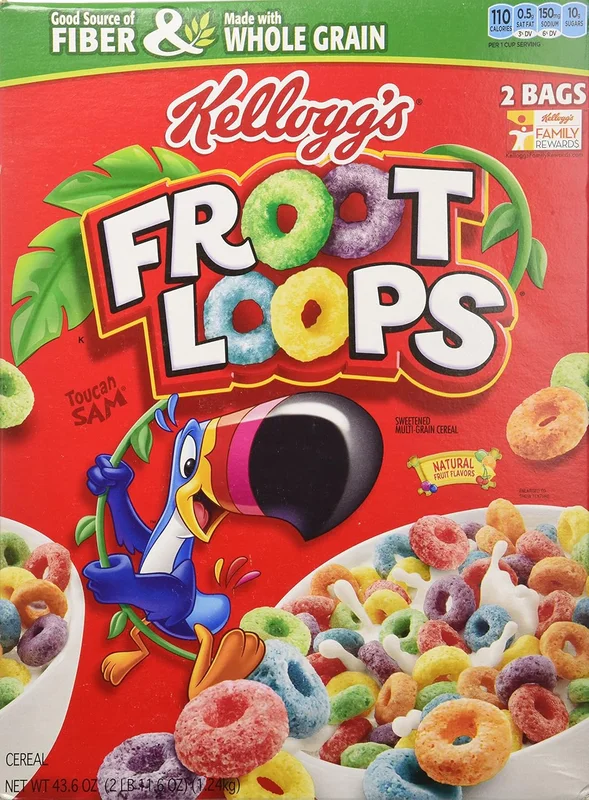
Where the cereal-aisle dye gap actually lives. In the EU these dyes are legal but carry the children's-activity warning label, so European cereals use fruit and plant concentrates instead.
So which box do you want?
If you want the simplest, least-sweet, fewest-ingredient cereal, the plain American Cheerio is, surprisingly, your answer. If you want more grain variety and don’t mind a sweeter, naturally-colored hoop, the UK multigrain delivers that. Neither is a health food; both are fortified processed cereals you eat with milk. But the instinct that the European box must be the virtuous one is, in this specific case, just wrong.
The useful lesson isn’t about Cheerios at all. It’s that “banned in Europe” and “cleaner in Europe” are different claims, and the food-comparison genre constantly smears them together. Sometimes the EU formula is stricter. Sometimes it’s just sweeter. The only way to know is to read both labels, which, it turns out, almost nobody pushing these comparisons actually does.
For the bigger version of this question (why returning travelers swear European food felt different), see Why do I feel better in Europe?. The honest answer there has very little to do with your cereal.